
News & Events
Announcement:
The Engage2Impact Self-Paced Programme is Now Open
Join this free online capacity development programme from the EngageSDGs project and learn how to apply participatory approaches to advance the Sustainable Development Goals.
Complete five practical modules at your own pace:
- Introduction to Participatory Approaches and the SDGs
- Foundations of Participatory Approaches and the SDGs
- Participatory Methods
- Case Studies for the SDGs in the SADC Region
- Resources and Tools for Participatory Approaches
The programme is open to university staff, students, community partners and anyone interested in sustainable development. Participants who meet the course requirements will receive a certificate of successful completion.
Register now and turn learning into impact:
UNCTAD candidate for the ISAR Honours 2026:
SARUA is pleased to report that the EngageSDG project has been identified by the United Nations Conference on Trade and Development (UNCTAD) as a potential candidate for the prestigious ISAR Honours 2026. The ISAR Honours recognize international best practices in sustainability and SDG reporting and are highly competitive, with approximately 450 initiatives from over 60 countries having been nominated since the programme’s inception in 2018.
The EngageSDG initiative was specifically acknowledged for its contribution to strengthening participatory approaches, sustainability engagement, and SDG impact within the SADC higher education sector. SARUA has been invited to submit a formal nomination by 31 May 2026. If selected, the initiative will be showcased at the ISAR 43rd Session at the Palais des Nations in Geneva, Switzerland (30 September – 2 October 2026), providing significant international visibility and opportunities for strategic partnerships and collaboration.
29 June 2026:
Final Integrated Participatory Framework document on the use of PAs towards the achievement of the SDGs

EngageSDGs Integrated Participatory Framework (IPF)
The framework is now available for implementation: engagesdg.softr.app
About PAs and the SDGs
How can you use participatory approaches in pursuit of the SDGs - and why should you?
Inclusive Participation and SADC
What to consider when applying participatory approaches in the SADC region.
Selection Criteria
What to consider when choosing your approach: Explore the various criteria that shape your decision-making process.
Search Directory
Have you familiarised yourself with the background information and selection criteria? Now you can use our search framework to identify your approach and method!
The IPF is an online tool that brings together knowledge related to the use of PAs for the SDGs, context-specific considerations on conducting inclusive PAs in the local realities of the SADC region, as well as in-depth reflections on the various criteria that help choosing the most appropriate approach and method considering your objectives, resources, participants and scope.
Most notably, the IPF presents a dynamic directory that allows you to search and filter PAs based on key criteria.
Participatory Approaches Directory
Are you ready to explore our directory and find the most suitable approach and method for your project? Reflect on the key criteria that will inform your decision and begin your search:
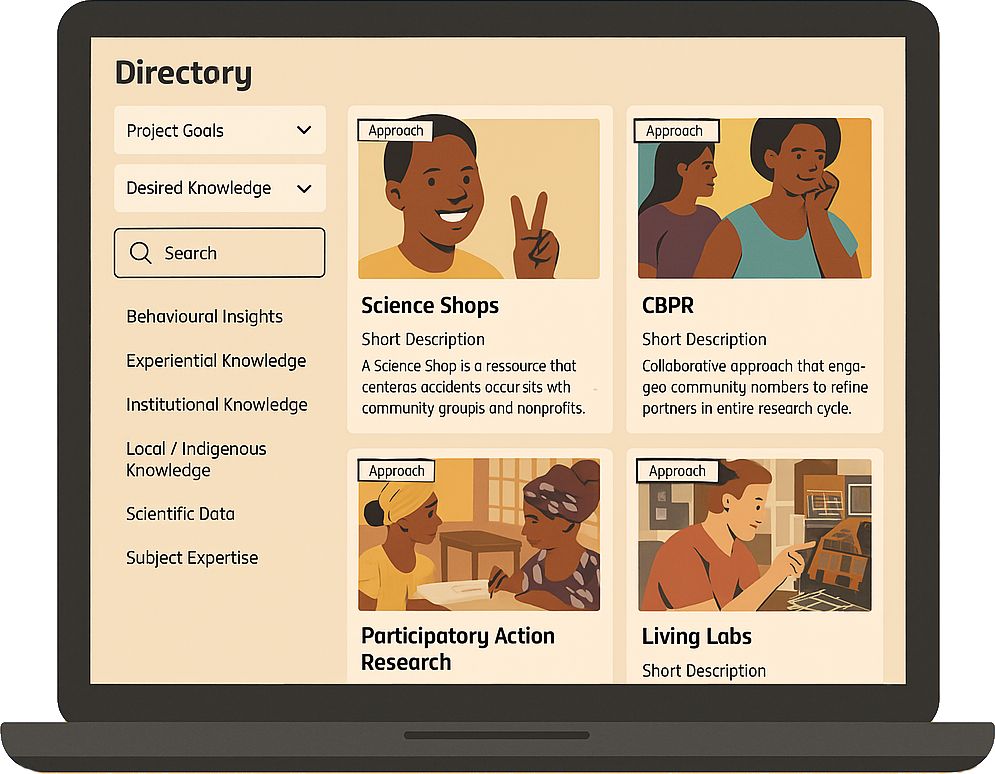
- Filter the approaches based on your needs and context.
- Click on an approach to learn more, explore examples and find guidance.
- For each approach, find the most suitable method for your project.
- Learn about the pros and cons of different methods and explore examples from the field.

For each of these approaches, you will find:
- in-depth information regarding the key criteria
- real-life examples in pursuit of different SDGs
- additional links to toolkits and handbooks
- a dynamic filter-based list of appropriate methods to apply in your particular context
For each of the related methods, you will again find:
- in-depth information
- real-life examples
- toolkits and handbooks
By integrating background reflections, in-depth information, real-life examples and external toolkits in one dynamic search platform, the IPF will guide HEIs in the SADC region, empowering them to drive impactful participatory engagement for the SDGs.
We welcome your feedback!
Events
| DATE | LOCATION | INFORMATION | |
|---|---|---|---|
|
5–9 October 2026 |
Hosted by University of Cork in Ireland |
Case-based learning and validation: The visit provides a learning immersion hosted by University College Cork (UCC), where partners engage with real-world case studies of participatory approaches and engaged scholarship. The aim is to benchmark, validate, and strengthen EngageSDGs outputs, about the IPF, digital ecosystem, and institutional engagement models, through exposure to applied practice. Project planning and updates: The visit also functions as a focused working platform to complete the project, ensuring that all deliverables, milestones, and engagements are finalised, evidenced, and aligned. This includes closing gaps (especially WP6), consolidating outputs, capturing all activities and starting preparations for a coherent, audit-ready final report. |
|
|
29 June 2026 |
Virtual workshop |
Participatory Approaches for SDG Action in SADC Higher Education EngageSDGs One-Day Virtual Capacity Development Programme The workshop aims to equip higher education leaders and practitioners with practical participatory approaches and tools to co-create contextresponsive SDG solutions with communities, industry and policymakers across the SADC region, while strengthening the role of universities as relevant and responsive partners in society. |
|
|
20 May 2025 |
Hosted by Unicaf Zambia Hybrid meeting |
Interregional Dialogue The meeting was a webinar aimed at exploring and promoting participatory approaches (PAs) in higher education. Participants from various regions and sectors shared strategies, best practices, and experiences related to integrating PAs into teaching, research, and community engagement. The session emphasized the role of universities in driving societal change and advancing the Sustainable Development Goals (SDGs), while showcasing the importance of collaboration and inclusive development. ➞ To enable interregional dialogue that encouraged knowledge exchange and collaboration on how participatory approaches can enhance community engagement and support the implementation of the SDGs in higher education. |
|
|
25-26 November 2024 |
Hosted by University of Mauritius and the Technical University of Mauritius Hybrid meeting |
Partner Work Meeting This was a Partner Work Meeting focusing on creating an Integrated Participatory ➞ To identify the components for the IPF based on inputs through the desktop studies and surveys conducted leading to the development of a matrix of options within selected SDGs. |
|
|
18 – 20 March 2024 |
Hosted by University of the Western Cape, Cape Town, South Africa Hybrid meeting |
First Partner Meeting/Kick-Off The Workshop was hosted in hybrid format and attended by representatives from all partner All partners agreed on the work that needs to be done in preparation for the initial physical project planning meeting, specifically: ➞ Develop a project work plan and establish responsibilities. |
|
|
26 January 2024 |
Virtual, Full partner meeting |
Introductory partner meeting The workshop was hosted virtually and attended by representatives from all partner institutions. The following objectives were set: ➞ Provide a historical background of the programme |
Participatory approaches to attaining SDGs
in Higher Education
In the context of higher education, the participatory approach to implementing the Sustainable Development Goals (SDGs) entails actively engaging various stakeholders within academic institutions, including students, faculty, administrators, researchers, and local communities, in the process of decision-making, planning, and executing actions towards achieving the SDGs.